Explore
Msheireb Downtown Doha
Msheireb Downtown Doha is a 31-hectare, heritage-led regeneration of Doha's old commercial core: a pedestrian-first district of LEED Gold- and Platinum-certified buildings, four heritage-house museums, and Barahat Msheireb plaza, all built around Msheireb metro station, the network's largest interchange (source: Msheireb Properties; Wikipedia, accessed 2026-08-26).
What is Msheireb Downtown Doha?
Msheireb Downtown Doha sits directly across from Souq Waqif, with the Amiri Diwan as its northwest neighbour, on a site the district's developer, Msheireb Properties, gives as 31 hectares (77 acres), around 310,000 square metres (source: Msheireb Properties; Wikipedia, accessed 2026-08-26). Msheireb Properties is a subsidiary of Qatar Foundation, and it markets the project as the world's first sustainable downtown regeneration and among the smartest cities anywhere, framing worth noting as the developer's own positioning rather than an independently verified ranking (source: Climate Action, Msheireb Properties, accessed 2026-08-26).
Construction started in 2010. Msheireb Properties' own site states the district was completed in 2021, while Wikipedia dates the final construction phase to February 2022, so treat 2021 to 2022 as the practical completion window rather than a single fixed date (source: Msheireb Properties; Wikipedia, accessed 2026-08-26). Total construction cost is widely reported at roughly QR20 billion (about US$5.5 billion), corroborated independently by trade-press coverage (source: Climate Action; Wikipedia, accessed 2026-08-26).
Why is Msheireb called a "smart, sustainable" district?
Msheireb Properties' own sustainability figures list 50 LEED Platinum-certified buildings and 49 LEED Gold-certified buildings across the site, described by the developer as one of the highest concentrations of Gold- or Platinum-rated buildings anywhere (source: Msheireb Properties, 2026). Energy consumption runs roughly 30% lower than a comparable conventional development, helped by 6,400 photovoltaic panels and 1,400 solar thermal panels with a combined 1.4 MW capacity (source: Msheireb Properties, 2026; Wikipedia, accessed 2026-08-26).
- District cooling and high-performance building envelopes cut energy demand.
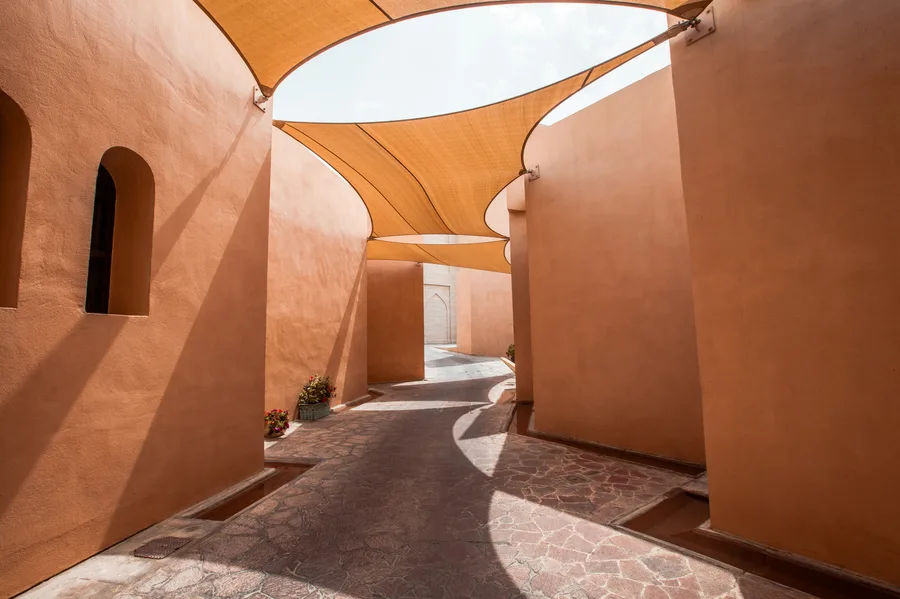
- Streets are oriented to funnel cooler sea breezes and shade the main pedestrian routes (source: Wikipedia, accessed 2026-08-26).
- An automated underground waste system separates recyclables at collection.
- A dense fibre and Wi-Fi network underpins parking, retail and navigation apps for visitors.
What does Msheireb Downtown Doha look like architecturally?
The district was built in six phases; HOK's Washington, D.C. studio led design of the final phase, Phase 4's Business Gateway Quarter, 15 buildings covering offices, residences, a medical building, a hotel and retail space, all achieving LEED Gold certification (source: HOK, accessed 2026-08-26). Rather than one signature tower, Msheireb spreads its identity across dozens of buildings that revive traditional Qatari references at scale: a street grid echoing historic Doha's own layout, custom ironwork drawing on regional natural and cultural patterns, stone and precast exteriors that limit solar heat gain, and T-shaped windows with light shelves that bounce daylight indoors without the glare of direct sun (source: HOK, accessed 2026-08-26).
None of this is decorative alone. Building massing and orientation double as climate control, shading pedestrian routes at street level while letting Gulf sea breezes move through the district, the same design logic behind the 30% energy saving Msheireb Properties reports for the wider site (source: HOK; Msheireb Properties, 2026, accessed 2026-08-26). The result reads closer to a low-rise heritage quarter with a handful of taller towers than the glass-and-steel skyline of West Bay a few kilometres north, a deliberate contrast worth knowing before you arrive expecting another cluster of skyscrapers.
What are the Msheireb Museums?
Four restored courtyard houses, each built between roughly 1900 and 1920 in a traditional Qatari style, now operate as individual museums under the Msheireb Museums banner. Bin Jelmood House covers the history of slavery and human exploitation across the Indian Ocean world; Company House, the former headquarters of Qatar's first oil company, tells the story of the country's early petroleum workers; Mohammed Bin Jassim House, built by a son of modern Qatar's founder, traces Doha's history and Msheireb's own transformation; and Radwani House recreates traditional Qatari family life (source: Msheireb Museums; Visit Qatar; Wikipedia, accessed 2026-08-26). None of these overlap with the Museum of Islamic Art or the National Museum of Qatar covered on this site's Doha museums guide; the four heritage houses are a separate, smaller-scale, free-standing museum group specific to this district.
Opening hours and ticket prices for the Msheireb Museums were not published with enough certainty to state here; confirm current hours, admission and any closure days directly at msheirebmuseums.com or by phone (+974 4006 5555) before planning a visit.
What's at Barahat Msheireb?
Barahat Msheireb is the district's central plaza, promoted by Msheireb Properties as the largest open-air covered pedestrian square in the region. It hosts a rotating events calendar: open-air cinema seasons, orchestral concerts run with the Qatar Philharmonic Orchestra, art installations and conferences have all used the space in recent programming (source: Msheireb Properties event listings, accessed 2026-08-26). Around the plaza and the wider district, Msheireb Properties lists more than 300 retail outlets plus the Msheireb Galleria Mall, with dining spread throughout rather than concentrated in one food court, ranging from casual streetside cafés to sit-down restaurants inside the heritage-style arcades.
When is the best time to visit Msheireb?
Late afternoon into evening works best, once the sun drops and Barahat Msheireb's cooling street orientation actually pays off; the same district design that shades pedestrians by day makes the plaza pleasant for a longer sit-down dinner after dark. Evening also lines up with most of the recurring programming, open-air cinema seasons, orchestral concerts and art installations tend to run after sunset rather than at midday (source: Msheireb Properties event listings, accessed 2026-08-26). Pair a Msheireb evening with an earlier stop at Souq Waqif, since both sit within a short walk of each other and neither needs a car in between.
Is Msheireb Downtown Doha walkable?
Yes, more than most of Doha. This site's own things-to-do guide already flags Msheireb, alongside Souq Waqif and the Corniche, as one of the few genuinely walkable pockets of an otherwise car- and taxi-dependent city, and that stands up on reverification: covered walkways, breeze-oriented street layouts and the pedestrian-only Barahat Msheireb square all reduce the need for a car once you're inside the district (source: Msheireb Properties; Wikipedia, accessed 2026-08-26). Souq Waqif sits directly across Grand Hamad Street, close enough to walk in a few minutes; see the Souq Waqif guide for what's on that side.
Is Msheireb station really the metro's main interchange?
Yes, and this also checks out against the claim already published on this site's things-to-do guide. Msheireb is the Doha Metro's largest station and the only point where all three lines, Red, Green and Gold, physically meet, spread across four levels roughly 40 metres underground; the Red and Green lines share platforms, while the Gold Line runs on a perpendicular level to the east (source: Wikipedia, accessed 2026-08-26). The station won a 2020 Prix Versailles World Special Prize for its interior, a reasonable proxy for how deliberately it was designed as more than a transit box (source: Wikipedia, accessed 2026-08-26).
Practical info: getting to and around Msheireb
- Arrive by metro directly at Msheireb station, the network's central interchange.
- Walk in from Souq Waqif across Grand Hamad Street in a few minutes.
- Expect full pedestrian access once inside the district; a companion app handles parking, retail directory and navigation for anyone driving in.
- Budget separate time and a separate ticket for the Msheireb Museums; the district itself and Barahat Msheireb cost nothing to walk through.
- Go for shaded streets, not open-air heat exposure: the district's cooling-oriented design makes it one of the more comfortable areas to walk in Doha's warmer months, though no independent temperature data was found to quantify that difference.
- Dress modestly, as in any public area of Doha: there is no legal dress code for visitors, but Visit Qatar's own guidance asks men and women to keep shoulders and knees covered (source: Visit Qatar guidance, accessed 2026-09-15).
Frequently Asked Questions
What is Msheireb Downtown Doha?
A 31-hectare (77-acre) heritage-led regeneration of Doha's old commercial core, developed by Msheireb Properties (a Qatar Foundation subsidiary) as a pedestrian-first smart city with LEED Gold- or Platinum-certified buildings throughout (source: Msheireb Properties, 2026; Wikipedia, accessed 2026-08-26).
What are the Msheireb Museums?
Four restored early-20th-century courtyard houses turned into museums: Bin Jelmood House (slavery and human exploitation), Company House (Qatar's early oil workers), Mohammed Bin Jassim House (Doha's history and Msheireb's transformation), and Radwani House (traditional Qatari family life), source: Msheireb Museums; Visit Qatar; Wikipedia, accessed 2026-08-26.
Is Msheireb Downtown Doha walkable?
Yes. Streets are oriented to catch Gulf sea breezes and shade pedestrian routes, and the district centres on Barahat Msheireb, described by its developer as the region's largest open-air covered pedestrian square (source: Msheireb Properties, 2026; Wikipedia, accessed 2026-08-26).
Is Msheireb station really the Doha Metro's main interchange?
Yes. Msheireb is the network's largest station and the only one where all three lines (Red, Green, Gold) meet, roughly 40 metres deep across four levels (source: Wikipedia, accessed 2026-08-26).
Is Msheireb Downtown Doha free to visit?
Walking the district, Barahat Msheireb and the retail streets is free. The Msheireb Museums charge a separate admission; check msheirebmuseums.com or call +974 4006 5555 for current hours and tickets before visiting.
Continue exploring: Souq Waqif, a few minutes' walk away, or the full things-to-do guide for how Msheireb fits into a wider Doha itinerary.